
Choosing guitar strings: which suit your guitar and playing style?
Gitaar Afstellen Nederland
Your choice of guitar strings seriously impacts the sound of your instrument. The question “which strings should I choose?” is one we hear all the time in our workshop. Understandably so, because the range on offer is huge and the right choice varies by instrument, playing style and tuning. Ernie Ball, D’Addario or perhaps Elixir? In this blog we run through all the different string types for each instrument.
Strings for electric guitar
The most commonly used gauge for electric guitar is 0.010″ – 0.046″, measured from the high E string to the low, thickest E string. This is regarded as the standard for electric guitars. The right string choice, however, depends on your playing style. A popular set for guitarists who prefer thinner strings is 0.009″ – 0.042″. Thinner strings require less strength, ideal for effortless bends and vibrato. But they also put less tension on the neck, which usually calls for a quick truss rod check after a change. Thicker strings give more volume and sustain, but demand more finger strength. Do you play in alternative tunings such as Eb standard? Then consider a heavier set. For the well-known ‘Drop D’ tuning we recommend strings with a so-called ‘heavy bottom’. These sets have an extra thick low E string.
In terms of material, nickel-plated steel is the standard: warm, balanced and easy on the fingers. Pure nickel sounds slightly softer and a touch darker. Stainless steel, on the other hand, is considerably brighter and resists corrosion for longer, but feels noticeably stiffer. For most players, roundwound strings (with the ridged, ribbed outer winding) are the norm. Flatwound strings, on the other hand, have a smooth and flat winding and are often chosen by jazz guitarists for their darker, vintage sound.
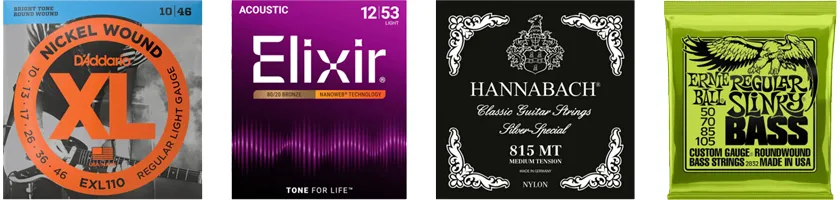
Our tip: D’Addario EXL110 (0.010″ – 0.046″)
Strings for acoustic guitar
When it comes to steel acoustic guitar strings, it’s mainly about the bronze alloy. An 80/20 blend sounds bright and direct, but loses that sparkle relatively quickly. A ‘phosphor bronze’ set contains a small amount of phosphorus, which makes the string sound warmer and last a little longer. Gauge-wise, light (0.012″ – 0.053″) is the most popular choice: a good balance between volume and playability. Medium (0.013″ – 0.056″) gives more projection and that classic steel-string tone, but takes considerably more finger strength. Bear in mind that switching to a heavier set often means your guitar will need setting up again.
Our tip: so-called ‘coated’ strings from Elixir, for example. These are covered with a thin polymer layer and typically last two to three times longer before going dull. They’re often a little more expensive, but nonetheless ideal for guitarists who play daily and want a consistent sound throughout the life of the string.
Our tip: Elixir 11052 Nanoweb (0.012″ – 0.053″)
Strings for classical guitar
Classical guitars use nylon strings, graded by tension class: light, medium/normal and high/hard tension. Higher tension gives more volume and a firmer feel under the fingers, but also puts more pressure on the neck and the top. Not every classical guitar can handle this, as traditional Spanish guitars often have no truss rod to correct the neck. On classical sets the thinnest three strings are made of clear nylon (clear or rectified). Rectified is ground more precisely for purer intonation. The thickest three strings have a nylon core wound with silver-plated copper. Nylon strings stretch a great deal, so bear in mind that with a new set you’ll be doing a lot of tuning over the first few days.
Our tip: Hannabach 815MT Silver Special Medium
Strings for bass guitar
Roundwound strings are by far the most popular strings for bass guitar. They sound bright, with plenty of overtones and attack. Going for that classic Motown sound? Then flatwounds are the right choice, as they sound darker and rounder. Thanks to the smooth winding they last a long time, as less dirt gets trapped in them. Many bassists swear by them and claim that years-old flatwounds sound better than brand-new ones. Halfround (or groundwound) strings sit between roundwounds and flatwounds in both feel and sound.
Our tip: Ernie Ball 2832 Regular Slinky (0.050″ – 0.105″)
Why new strings call for a fresh setup
A different string gauge means different tension on the neck, and that means the truss rod needs correcting. On top of that, your action (i.e. the height of the strings above the frets) changes when you switch to a set of a different gauge. Want to learn to set up your instrument yourself? Our setup guides walk you through it per instrument: learn to set up your acoustic guitar, electric guitar, classical guitar or bass guitar yourself.
Need a hand with the setup after all? Our experienced luthiers are ready to help and will make sure your instrument sounds, plays and looks like new again. Need a specific set of strings? No worries, we’re happy to order them for you. For this we work with Snarenshop.nl, which gives us the largest range of strings in the Netherlands to choose from. Just let us know which strings you’re after and we’ll order them for you at a favourable rate. That way, we’ll make sure your guitar sounds the way it should again, tailored to your playing style.

Music is my greatest passion. From a young age, I’ve been writing songs and playing in bands. As an artist, my life is deeply intertwined with everything music-related. Next to designing tools to help people learn music theory for Wheel of Fifths, I’ve been working as a luthier since 2020, repairing, restoring and building all kinds of guitars and basses. Book an appointment at my workshop in Groningen via the contact form.