
Cleaning and maintaining the fretboard of your guitar or bass: how does it work?
Gitaar Afstellen Nederland
Does your fretboard look dull and greyish, and does it feel rough or dry? It’s something we see a lot on the guitars that come into our workshop, and it usually comes down to a fretboard that desperately needs some loving. We’re happy to explain why this happens and how to sort it out yourself in four simple steps.
Why a fretboard needs to be maintained
The fretboard on most guitars is untreated wood. Rosewood, ebony and pau ferro are deliberately left unfinished: your fingers need to glide across them freely, and a lacquer coat would get in the way of that. That’s great for playing, but it also means the wood dries out more quickly.
In winter, with the heating on, the humidity in your home drops considerably. Wood gives off moisture and shrinks. You notice it sooner than you might think: the fret ends start to protrude slightly, so you feel them catching along the side of the neck. At a more advanced stage you get hairline cracks, and by then you’re a long way past what a tin of wax can fix. On top of that, skin oil, sweat and dust build up, especially against the frets, which ultimately makes the neck feel sluggish rather than fast. A good treatment therefore does two things at once: it nourishes the wood and protects it from absorbing dirt, sweat and dust. Therefore, we recommend making a habit of cleaning and conditioning the fretboard each time you change strings.
Our advice: keep your guitars in a room at around 50% humidity and don’t store them next to a radiator or in direct sunlight. If you’re not playing your guitar for some time, it’s advisable to store it in a case.
Step 1. Checking whether your fretboard is finished (lacquered) or untreated
This is where most mistakes are made. Unfinished fretboards need conditioning, whereas finished or lacquered ones don’t. Avoid using any product on a finished fretboard, as whatever you rub on stays on the surface and turns into a sticky layer.
Not sure whether your fretboard is finished? You can usually tell quite easily by touch: a finished fretboard feels very smooth and shines when you hold it up to the light. Most maple fretboards are finished, whereas rosewood is almost always left unfinished.
Step 2. Removing the strings and cleaning the fretboard
To reach the spots where dirt collects, you’ll need to take the strings off the guitar. After that you can clean the fretboard. If there’s a stubborn layer of grime on it, use extra-fine steel wool (0000) and always rub along the grain, never across it. Mask off the pickups with some masking tape or a cloth to keep the steel wool dust away from the pickup magnets. For cleaning and degreasing an unfinished fretboard, we recommend naphtha or lighter fluid. Put a few drops on a piece of kitchen towel or a soft cloth and wipe the fretboard clean. The product evaporates completely and leaves no residue, so the wood doesn’t get saturated. Then wait a few minutes until it’s properly dry. Be careful with regular guitar cleaner products: these often leave a thin layer of silicone behind, which stops whatever you put on next from properly nourishing the fretboard wood.
Step 3. Applying the wax
Apply the wax with a dry, clean cloth or simply with your finger. Try to spread it evenly and be sure to also work it into the edges around the frets. The point is to get the wax properly into the grain of the wood. Always use natural products to condition the fretboard. Try to avoid lemon oil: these products contain aggressive solvents that dry the fretboard out in the long run.
Leave the wax to soak in for five to ten minutes. Afterwards, wipe the fretboard clean with a dry cloth or a piece of kitchen towel. Properly nourished and conditioned wood looks matt and feels dry. Not wet, and definitely not rough.
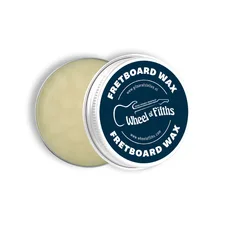
Our tip: try our Fretboard Care Wax 100g (€19.95), made from 100% organic beeswax and a natural mineral oil.
Step 4. Installing new strings and tuning up
Now it’s time for restringing. How to tie or knot strings is covered in our blog about changing guitar strings. Not sure which type of strings best suit your playing style? Be sure to check out our blog “all about strings”. If you switch to a different string type, keep in mind that the neck or saddles sometimes need to be adjusted.
What else you can use our Fretboard Care Wax for
Our wax is made for more than just the fretboard. It’s also suitable for lubricating the nut slots and the bridge saddles, which helps your guitar stay in tune better. Does your guitar still keep going out of tune? Then read our blog about five possible causes. You can also use wax to lubricate screw holes, which makes a screw bite more easily. Our wax can also be used to condition an unfinished neck or body.
What others think
About Wheel of Fifths
Our guitar care products are available via Wheel of Fifths. Besides guitar accessories, Wheel of Fifths is a great resource for learning music theory.
Need some help?
With each setup done by one of our luthiers, the fretboard is carefully cleaned and conditioned. Do you see any hairline cracks, protruding fret ends or frets that are clearly worn down? We’re more than happy to take a look at it. Feel free to drop by one of our nine locations throughout the Netherlands. Use the booking form to arrange an appointment at a location near you.

Music is my greatest passion. From a young age, I’ve been writing songs and playing in bands. As an artist, my life is deeply intertwined with everything music-related. Next to designing tools to help people learn music theory for Wheel of Fifths, I’ve been working as a luthier since 2020, repairing, restoring and building all kinds of guitars and basses. Book an appointment at my workshop in Groningen via the contact form.