
How to darken your guitar fretboard: what does a stain or relic wax do?
Gitaar Afstellen Nederland
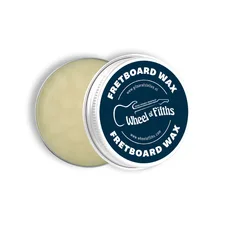
Some guitars naturally have it: a fretboard that has turned beautifully dark and warm after years of playing, with a little more depth in the grain. Other guitars leave the factory with lighter fretboards. And rosewood that hasn’t properly been cared for can fade and dry out over time, turning into a washed-out greyish brown. But no worries, this can easily be fixed. For that we use a relic wax: our own Fretboard Stain Wax. In this blog we explain what a stain wax actually does, which woods it works on and how to apply it in five simple steps.
What a stain wax does and doesn’t do
A stain wax colours the wood of your fretboard and deepens the grain. It’s designed to make the wood of a cheaper guitar look like the deep pigment you find in (often expensive) rosewood fretboards. The pigment in the stain soaks into the top layer of the wood. The result is a fretboard that looks permanently darker, with more contrast between the grain and the wood around it.
What it isn’t: it doesn’t colour the wood right through to the core. A stain wax only soaks into the top layer of the wood, which is why it looks natural rather than painted. It also only colours the wood, not the frets or inlays. So you can apply it generously.
Our Fretboard Stain Wax is made from the same nourishing ingredients as our Fretboard Care Wax and contains 100% organic beeswax and a natural mineral oil. The difference is the pigment it contains, so it nourishes and colours the fretboard at the same time. Just to be sure, we do recommend to use the Care Wax after colouring the fretboard.
Please note: it’s still a stain, and the effect on your guitar is permanent. And not just on your guitar: on your workbench and clothing too, so please be careful. Stains are hard to remove, so be sure to use gloves and plenty of old cardboard to work on.
Which woods does it work on?
You get the best result on light fretboards made of untreated, open-grained wood. Think of the laurel and poplar you come across on cheaper Stratocasters, or rosewood that has faded over the years. That’s exactly where the difference is greatest. On ebony you see the least effect, simply because there isn’t much left to darken on wood that’s almost black already.
Results may vary from instrument to instrument. The harder and denser the wood, the less pigment can soak into the grain. On a dense fretboard you’ll need more coats than on an open, porous one. On finished fretboards, on the other hand, it won’t work at all. There’s a lacquer coat on top of the wood, preventing the wood from absorbing any product. Therefore, never use the product on a finished fretboard.
Not sure whether your fretboard is finished? It’s quite easy to find out. A finished or lacquered fretboard feels smooth and shines when you shine a light on it. Most maple fretboards are finished. Rosewood fretboards, on the other hand, are almost always left unfinished.
Step 1. Cleaning and degreasing the fretboard
This is what makes or breaks the result. On a fretboard that’s still greasy, the stain won’t penetrate the wood at all. Therefore, remove the strings and clean the fretboard thoroughly first. If there’s a stubborn layer of grime on the fretboard, use extra-fine steel wool (0000) to remove the dirt. Make sure you mask off the pickups with some masking tape or a cloth to keep out the steel wool dust. Next, it’s important to degrease the fretboard. For this we recommend naphtha or lighter fluid. It dissolves all oils and grease and dries the wood out, which is exactly what you want to make sure the stain can penetrate the wood properly. Put a few drops of naphtha or lighter fluid on a piece of kitchen towel or a soft cloth and wipe the fretboard clean. It will evaporate completely and leaves no residue, unlike regular guitar cleaner products, which aren’t suitable when cleaning a fretboard before applying a stain. If your cleaning cloth gets very dirty, be sure to go over the fretboard a second time, and leave the fretboard to dry for a few minutes.
Please note: a regular fretboard cleaner such as Dunlop Formula 65 isn’t suitable here. It leaves a protective layer of silicone behind, which prevents the stain wax from soaking into the wood.
Step 2. Applying the Fretboard Stain Wax
Apply a thick coat across the entire fretboard, from the nut to the last fret, and rub it in firmly with a clean cloth. Don’t be afraid to use a bit of pressure: you want to push as much pigment into the grain as possible. The wax only soaks into the wood of the fretboard, so don’t worry about the frets and inlays.
Step 3. Letting it soak in and wiping it off
Now it’s a matter of waiting, and this is the step where most people are too impatient. The longer the stain stays on the wood, the darker the result. We recommend letting the stain soak in for around three to six hours. Longer is always fine, and you can happily leave it overnight. After that, wipe the excess wax off with a piece of kitchen towel, and let the fretboard dry for a few hours.
Step 4. Repeating until you have the desired colour
You never reach the darkest shades in one go. A first coat will always be fairly subtle, and only on a second or third coat will you get a really nice dark colour. Apply the next coat in exactly the same way as the first and repeat until you’re happy. For the best result, we recommend a minimum of three thick coats across the fretboard.
Step 5. Sealing it with Fretboard Care Wax
Happy with the colour? Then it’s time to condition the fretboard. Use our Fretboard Care Wax and rub it in well. The wax seals in the colour and nourishes and conditions the wood again. That last part is absolutely necessary, because the naphtha or lighter fluid will have degreased the fretboard completely. After that, you can fit new strings and tune the guitar.
Our tip: both the Fretboard Stain Wax 100g (€24.95) and the Fretboard Care Wax 100g (€19.95) can be ordered through Wheel of Fifths.
How dark does it get, and how long does it last?
The effect of the stain is permanent, although after one coat it will still be fairly subtle. After around three coats, you can expect the fretboard to turn quite dark, giving a nice vintage look. Curious about other people’s experiences? Nunzio from GitaarVriend has written a blog about using the Stain Wax.
What others think
About Wheel of Fifths
Our guitar care products are available via Wheel of Fifths. Besides guitar accessories, Wheel of Fifths is a great resource for learning music theory.
Need some help?
Would you rather have us apply the wax for you? No problem at all, feel free to bring your guitar to one of our locations. We’ll degrease, colour and condition the fretboard in our workshop and fit a fresh set of strings. Use the booking form to arrange an appointment at one of our nine locations.

Music is my greatest passion. From a young age, I’ve been writing songs and playing in bands. As an artist, my life is deeply intertwined with everything music-related. Next to designing tools to help people learn music theory for Wheel of Fifths, I’ve been working as a luthier since 2020, repairing, restoring and building all kinds of guitars and basses. Book an appointment at my workshop in Groningen via the contact form.